Skip to main content

What is Gold ETF: Meaning, how it works & Taxation

8 min read31 Jul 2025

What is Gold ETF: Meaning, how it works & Taxation

A Gold ETF (Exchange-Traded Fund) is a mutual fund that tracks the price of domestic physical gold. Each unit typically represents 1 gram of gold in electronic form, backed by 99.5% pure physical gold bars. Gold ETFs trade on stock exchanges like NSE and BSE, allowing investors to buy and sell them just like shares through a Demat account and broker.

Gold ETFs offer price transparency, high liquidity, and lower costs compared to buying physical gold, as they eliminate making charges and storage concerns. On redemption, investors receive the cash equivalent, not physical gold.

Key Features of Gold ETFs

  • High Purity: Gold ETFs represent 99.5% pure physical gold bars.
  • Exchange-Traded: They are bought and sold on NSE and BSE during market hours.
  • Demat Holding: Units are held electronically in a Demat account, avoiding physical storage.
  • Uniform Pricing: Gold ETFs have consistent prices across all regions in India.
  • High Liquidity: They can be easily traded through brokers anytime the market is open.
  • Low Costs: Investors pay minimal brokerage and management fees, no making charges.
  • Transparent: NAV and holdings are published daily for full transparency.
  • Convenient: Investing and managing Gold ETFs is simple and done online.

Gold Exchange-Traded Funds: A Quick Definition

Gold Exchange-Traded Funds (Gold ETFs) are mutual fund schemes that invest in physical gold and aim to mirror domestic gold prices. Each unit typically represents 1 gram of 99.5% pure gold bars, held in electronic (Demat) form. These funds are traded on stock exchanges like the NSE and BSE, offering the convenience of stock trading with the safety and purity of gold investment.

Gold ETFs provide a cost-effective, liquid, and transparent way to invest in gold, without the hassles of storage or making charges. For investors considering where to put their gold exposure, understanding gold allocation in portfolio is essential.

How Does a Gold ETF Work?

  • Gold Exchange-Traded Funds (ETFs) are investment instruments that represent ownership in high-purity gold (99.5%), held in a dematerialized format. Each unit of a Gold ETF typically equals 1 gram of gold and is traded on major stock exchanges such as the NSE and BSE, similar to shares.
  • Unlike physical gold, which can have varying prices across locations, Gold ETFs offer consistent pricing across the country. Investors can buy or sell units during trading hours using a Demat and trading account via registered brokers. Transactions may include a brokerage fee and nominal fund management charges.
  • Gold ETFs provide a cost-effective and secure way to gain exposure to gold prices without the issues of storage or purity verification. This makes them an appealing option for investors seeking liquidity, transparency, and convenience in gold investing.

Benefits of Investing in Gold ETFs

Gold ETFs offer quality, real-time value, easy access, and tax-friendly benefits. They provide a safe and low-cost investment option with zero extra charges like making fees or storage hassles.

If you want to explore other options, understanding what is gold fund can give you insights into gold-focused mutual funds that invest indirectly in gold.

Risks and Considerations Before You Invest in Gold ETFs

Gold ETFs are influenced by market fluctuations and may experience minor tracking errors. While they might not be suitable for short-term gains, they can be a solid choice for long-term wealth preservation.

If you’re weighing your options, a comparison of gold ETFs vs gold mutual funds can help you determine which suits your investment goals better.

Gold ETF vs Physical Gold vs Gold ETF FOF vs Sovereign Gold Bonds

FeatureGold ETFPhysical GoldGold ETF FOFSovereign Gold Bonds (SGBs)
FormElectronic (demat)Physical (coins, bars, jewellery)Units of mutual fund investing in gold ETFsGovernment bond linked to gold prices
Purity99.5% purityVaries; risk of impurityBacked by ETFs, hence 99.5% purityEquivalent to 999 purity gold
Storage & SafetySafe (held in demat form)Risk of theft, requires storageSafe (no physical handling)Safe, held in RBI records or demat
LiquidityHigh (traded on stock exchanges)Moderate (depends on buyer/seller)High (redeem with AMC)The bond has an 8-year tenor with exit options in the 5th, 6th, and 7th year on interest payment dates.
ReturnsTracks gold price; no interestBased on gold priceSimilar to ETF returns, minus expensesGold price + 2.5% annual interest

For those weighing options, check the detailed comparison of sovereign gold bond vs gold etf and gold etf vs physical gold to understand which suits your needs best.

Taxation of Gold ETFs in India (FY 2025-26)

  • Short-Term Capital Gains (STCG) Profits from selling Gold ETF units held for 12 months or less.
  • Long-Term Capital Gains (LTCG) Profits from selling Gold ETF units held for more than 12 months.

For detailed provisions and updates, refer to the latest Kotak Tax Reckoner

Why Invest in Gold ETFs?

Gold ETFs are a convenient and efficient way to invest in gold without dealing with the hassles of physical storage or security. Each unit is backed by 99.5% pure physical gold and can be traded on stock exchanges just like shares, offering high liquidity and transparency in pricing. They eliminate concerns like making charges, GST, and storage costs associated with physical gold, while providing safety through electronic holding in a Demat account. Tax-efficient and accepted as collateral for loans, Gold ETFs also allow investors to start with small amounts, making them accessible for all types of investors.

How to Invest in Kotak Gold ETF?

  • Open a Demat & Trading Account
  • Login to Your Trading Platform
  • Search for Kotak Gold ETF ( NSE Symbol – Gold1, BSE Scrip Code - 590097)
  • Place a Buy Order
  • Monitor Your Investment

Who Should Consider Gold ETFs?

Gold ETFs are suitable for investors who want to gain exposure to gold without dealing with physical storage, prefer a low-cost and transparent investment option, seek easy liquidity through stock exchanges, and desire tax-efficient ways to invest in gold. They suit both beginners and seasoned investors looking for portfolio diversification or a hedge against inflation and market volatility.

How to sell or redeem Gold ETF?

To sell or redeem Gold ETFs, you need to place a sell order through your Demat and trading account just like selling any stock. Once you sell, the proceeds (cash equivalent) will be credited to your linked bank account.

FAQS

A Gold ETF is a fund that tracks the price of gold and is traded on stock exchanges. When you buy units, you indirectly own gold without holding physical metal.
You can buy as low as 1 unit, usually equal to 1 gram of gold. Investment depends on the current gold price.
Market price risk Expense ratio (management fees) No physical gold possession Brokerage fees Liquidity can vary
Cost equals the current gold price per gram (or unit weight), fluctuating in real time.
It tracks the live gold spot price and is influenced by demand and supply on the stock exchange.
Buy/sell through your broker on NSE/BSE like stocks during market hours.
Yes, units are backed by physical gold stored securely.
Fund houses may allow this option under specific conditions, such as a minimum redemption size. For most retail investors, Gold ETFs are meant for cash redemption only.
Yes, they are good for long-term investors who want exposure to gold without storage hassles and prefer easy buying/selling.
Gold ETFs are more liquid since they trade like stocks on exchanges and can be bought/sold anytime during market hours. Physical gold is less liquid due to storage, verification, and selling processes.
Gold ETFs are not risk-free because their prices fluctuate with the gold market, exposing investors to market risk. While they offer easier liquidity compared to physical gold, factors like tracking errors and management fees (expense ratio) can slightly affect returns. Additionally, although generally liquid, there can be rare instances of lower trading volumes. So, investing in Gold ETFs carries typical market risks and isn’t completely risk-free.

Disclaimers:

Kotak Gold ETF
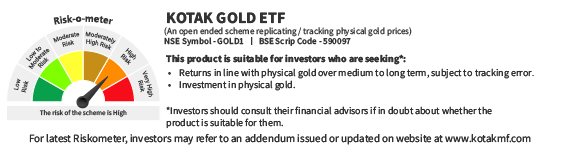
KOTAK GOLD ETF.webp
For Latest Riskometer, Investors may refer to an addendum issued or updated on website at www.kotakmf.com

These materials are not intended for distribution to or use by any person in any jurisdiction where such distribution would be contrary to local law or regulation. The distribution of this document in certain jurisdictions may be restricted or totally prohibited and accordingly, persons who come into possession of this document are required to inform themselves about, and to observe, any such restrictions.


Mutual Fund investments are subject to market risks, read all scheme related documents carefully.

Comments (0)

Share your Opinion

Start the conversation and be the first voice of this Article.